
Ultimate Guide to Scoring Band 6 in Chemistry: What Actually Works in 2026
This ultimate guide to scoring Band 6 in Chemistry is built for students who are done with guesswork and ready to study smarter. Here's something most students don't know: NSW HSC standards-setting can shift marks substantially, meaning a raw exam mark of 82 (just meeting Band 6) can map to an HSC exam mark of 90 after standards are applied. That means the gap between where you are and where you need to be is often smaller than it looks. But only if you study the right way.
| Question | Answer |
|---|---|
| What is Band 6 in HSC Chemistry? | Band 6 is the highest performance band in HSC Chemistry, typically requiring an aligned mark of 90 or above. |
| How hard is it to score Band 6 in Chemistry? | Chemistry is one of the most challenging HSC subjects, but with the right strategy and explicit learning structure, Band 6 is achievable. |
| What topics are covered in HSC Chemistry? | HSC Chemistry covers Modules 1 through 8, spanning physical, organic, and analytical chemistry across Year 11 and Year 12. |
| What study techniques work best for Band 6? | Active recall, spaced repetition, and guided practice are the most evidence-backed methods for retaining and applying Chemistry content. |
| Does tutoring help for HSC Chemistry Band 6? | Expert HSC Chemistry tutoring that uses explicit instruction and cognitive science can significantly accelerate results. |
| Is there a free resource to study smarter for HSC? | Yes. Our free HSC study guide covers science-backed strategies for Chemistry and other subjects. |
| How many modules are in HSC Chemistry? | Eight modules in total. Modules 1 to 4 are covered in Year 11, and Modules 5 to 8 in Year 12. |
Why Scoring Band 6 in Chemistry Starts With Understanding the Problem
Does this sound familiar? You're putting in the hours. You're reading your notes. You're highlighting textbooks. But when exam time comes, it doesn't translate.
Most schools teach what to learn, but they rarely teach how to learn. And Chemistry, more than almost any other HSC subject, punishes passive study hard.
The content is dense. The calculations are precise. And the exam questions are designed to test whether you genuinely understand concepts, not whether you've memorised a definition.
There is a better way to learn. And it's backed by science.
Know the NESA Syllabus Inside Out: Your Ultimate Band 6 Chemistry Blueprint
The NESA syllabus is not a suggestion. It's the exact roadmap examiners use when writing your Chemistry paper.
Every dot point is fair game. Every inquiry question matters. If you're not studying directly from the syllabus, you're leaving marks on the table.
Here's what the NESA syllabus for HSC Chemistry covers:
Module 1: Properties and Structure of Matter
Module 2: Introduction to Quantitative Chemistry
Module 3: Reactive Chemistry
Module 4: Drivers of Reactions
Module 5: Equilibrium and Acid Reactions
Module 6: Acid/Base Reactions
Module 7: Organic Chemistry
Module 8: Applying Chemical Ideas
Print it out. Work through it module by module. Treat every dot point as a learning objective you need to demonstrate mastery of, not just familiarity with.
We condense the syllabus and structure our lessons so that you gain the foundational knowledge you need to succeed. That structure matters. Without it, students often over-study easy content and under-prepare for high-mark areas.
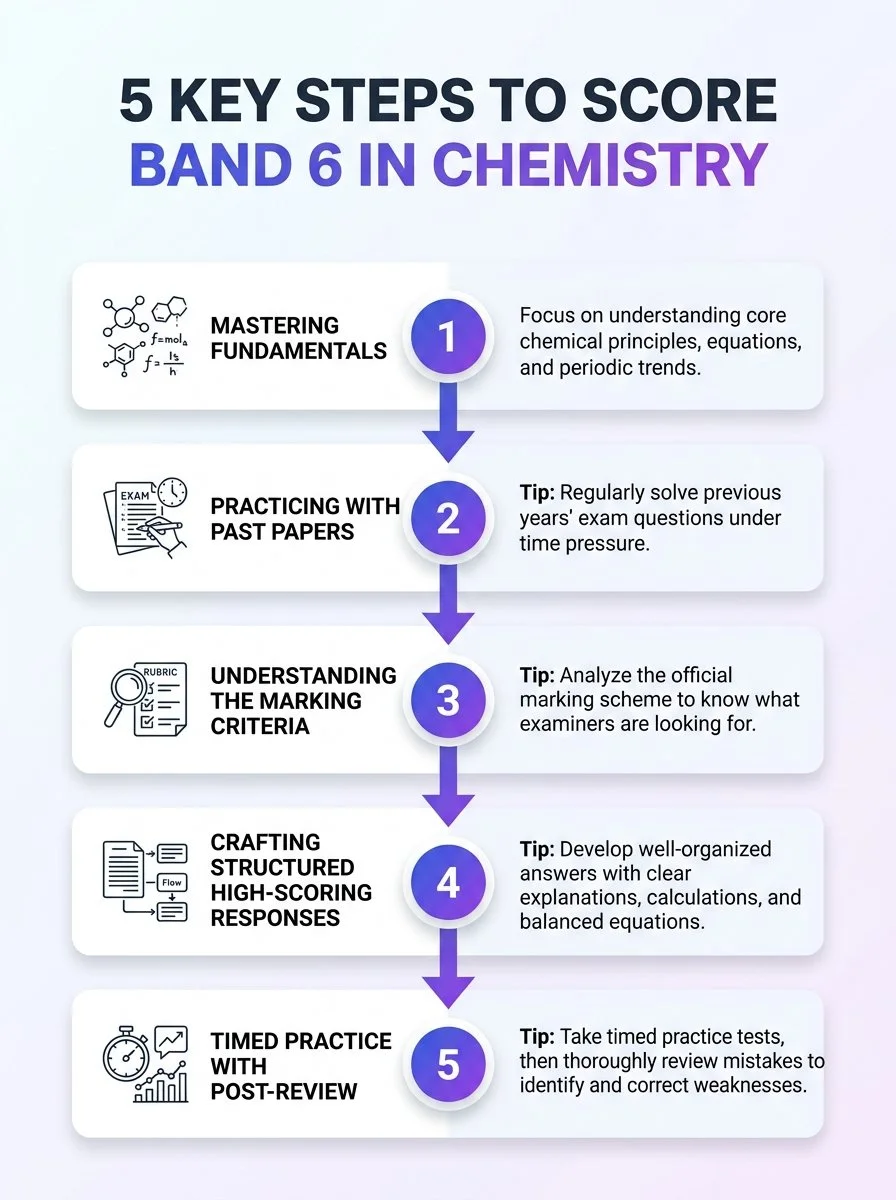
This infographic highlights five essential steps to score Band 6 in Chemistry. Use these strategies to focus your study and boost exam readiness.
The Science-Backed Study Method That Actually Produces Band 6 Results
Here's the truth most students resist: effort alone doesn't equal results. How you study determines how much you retain, recall, and apply under exam pressure.
Our tutoring method is based on a combination of cognitive science research and the experience of our high achieving tutors. And those two things point to the same set of core strategies.
1. Active Recall
Don't read and re-read your notes. Close them. Try to recall the content from memory.
Active recall forces your brain to retrieve information, which is the same mental process you'll need in the exam. Every time you successfully retrieve something, the memory trace gets stronger.
2. Spaced Repetition
Cramming feels productive. But it doesn't build long-term retention.
Spaced repetition fights the forgetting curve by spreading your study across sessions, returning to older content before it fades. Apps like Anki are built on this principle. So is our class structure.
3. Minimising Cognitive Load
Theory is broken down by our tutors into the smallest possible parts and taught with simple consistent language to students. Why? Because when you try to learn too much at once, you retain very little.
Breaking Chemistry down into digestible bites, one concept at a time, minimises the cognitive load and makes it far easier to build genuine understanding before moving on.
4. Guided Practice
Once you understand a concept, you need to practise applying it. That means worked examples, scaffolded problems, and then independent questions.
Guided practice bridges the gap between "I understand this in theory" and "I can do this under pressure in an exam."
How a Structured Class Model Drives Band 6 Chemistry Outcomes
Random study doesn't build mastery. A consistent, proven class structure does.
Here's the explicit learning structure we use in every Chemistry session:
Class Review: Rapid retrieval practice of previous concepts from past lessons. This fights the forgetting curve before it sets in.
Explicit Instruction: Theory is broken down into the smallest possible parts with simple, consistent language. No jargon overload. No cognitive overwhelm.
Guided Practice: Students work through problems with tutor scaffolding, building confidence and accuracy.
Independent Practice: Students tackle questions on their own, applying what they've learned without support.
Exit Test: At the end of the class, students are given a final exit test to assess their retention of class content.
Homework: Spaced review tasks that reinforce learning before the next session.
This isn't a random sequence. Each step is deliberately designed to maximise retention and build skills from the ground up.
We teach explicitly and build students' understanding from the ground up, then apply it to exams. That's exactly what Band 6 requires.
Module-by-Module: Where Band 6 Chemistry Students Focus Their Energy
Not all modules carry equal weight. And not all questions are equally difficult to score on.
Here's a practical breakdown of where to focus in the ultimate guide to scoring Band 6 in Chemistry:
| Module | Focus Area | Band 6 Priority |
|---|---|---|
| Module 1 & 2 | Atomic structure, mole calculations | High. Foundational for every later module. |
| Module 3 & 4 | Reactivity, thermodynamics, entropy | High. Frequent multi-mark questions. |
| Module 5 | Equilibrium, Le Chatelier's principle | Very high. Regularly tested in depth. |
| Module 6 | Acid-base calculations, buffers | Very high. Calculation-heavy, high marks. |
| Module 7 | Organic reactions, functional groups | High. Requires systematic learning. |
| Module 8 | Analytical techniques, spectroscopy | High. Depth of analysis is rewarded. |
Band 6 students don't just "cover" each module. They achieve genuine mastery, so that when an exam question twists a concept, they can still navigate it.
Exam Strategy: The Ultimate Guide to Scoring Band 6 in Chemistry Under Pressure
Knowing the content is only part of the equation. Performing in the exam room is a skill in itself.
Here's what separates Band 6 students from Band 5 students on exam day:
Read every question twice. Chemistry questions often have multiple parts. Missing a sub-question costs marks fast.
Use correct chemical notation always. State symbols, significant figures, and correct formulae matter in marking.
Show every step in calculations. Method marks are available even when the final answer is wrong.
Time your responses. Band 6 students don't spend 12 minutes on a 2-mark question.
Use the verb in the question. "Describe" and "explain" require different depths of response. Know the difference.
Practise past papers under timed conditions. Familiarity with the exam format reduces exam-day anxiety and cognitive load.
The exit test at the end of every class we run is built on the same principle: practise retrieving and applying content under conditions that mirror the real exam. The more times you do it, the more automatic it becomes.
Why Most Students Miss Out on Band 6 (And What to Do Instead)
Chemistry is one of the most challenging HSC subjects. It's not because the content is impossibly hard. It's because most students approach it the wrong way.
Here's what the Band 5 study pattern usually looks like:
Re-reading notes without testing recall
Skipping calculation practice because it feels hard
Studying all modules equally instead of prioritising high-yield areas
Leaving past paper practice until the week before the exam
Studying alone with no feedback loop
And here's what Band 6 looks like instead:
Active recall and spaced repetition from week one
Consistent, structured practice with instant feedback
Modular focus driven by the NESA syllabus
Past papers integrated throughout the year, not just at the end
Expert guidance that builds from the ground up
"There is a better way to learn. And it's backed by science."
How Expert Chemistry Tutoring Supports Your Band 6 Goal in 2026
Self-study has a ceiling. Without structured feedback, most students don't know what they don't know.
We're a team of passionate educators and dreamers, tutoring with purpose and clarity. We have small class sizes of 1-8 students so that we can tailor our support to the individual needs of our students.
That small class environment matters. It means:
Your questions get answered, not skipped
Misunderstandings are caught early, before they compound
You receive instant feedback on practice questions
Tutor attention is focused, not diluted across 30 students
Our Chemistry program uses a triad approach: Simplified Structure / Concept Focused / Mastery Orientated. Every lesson is built around those three pillars, and every lesson feeds directly into what NESA expects from a Band 6 student.
If you're in the Blacktown area, explore our HSC Chemistry tutoring program and see how we approach Modules 1-8 with that explicit learning structure. And if you're ready to start, our enrolment process is straightforward.
Free Resources to Help You Start Scoring Band 6 in Chemistry Today
Not sure where to start? We've made it easier.
Our free HSC study guide walks you through the science-backed study strategies that underpin everything in this ultimate guide to scoring Band 6 in Chemistry. It's practical, it's direct, and it covers how to study not just what to study.
No catch. No obligation. Just the tools you need to start studying smarter today.
If you'd like to explore our current offers, visit our promotions page. And if you have questions about our approach or programs, our tutoring FAQ covers the most common ones.
Conclusion: Your Ultimate Guide to Scoring Band 6 in Chemistry
Scoring Band 6 in Chemistry in 2026 is not about studying harder. It's about studying with the right structure, the right techniques, and the right support.
This ultimate guide to scoring Band 6 in Chemistry covers the core principles: master the NESA syllabus, use active recall and spaced repetition, follow an explicit learning structure, prioritise high-yield modules, and practise under exam conditions. Those five things, done consistently, move students from Band 5 to Band 6.
Most schools teach you what to learn. We teach you how to learn, from the ground up, in the smallest possible parts, with the cognitive science to back it up.
Ready to take the stress out of studying? Check out our Chemistry tutoring pricing, or dive straight into the free study guide and get started today.
Frequently Asked Questions
What mark do I need to get Band 6 in HSC Chemistry?
Band 6 in HSC Chemistry generally requires an aligned mark of 90 or above. Due to NESA's standards-setting process, a raw exam mark slightly below 90 can still map to a Band 6 result after alignment, which is why focusing on consistent, deep understanding across all modules is more effective than chasing a specific raw score.
How long does it take to prepare for Band 6 in Chemistry?
For most students, a full year of structured, science-backed study across Year 12 is the ideal preparation timeline for Band 6 in Chemistry. Students who begin with strong Year 11 foundations and use active recall and spaced repetition from the start of Year 12 tend to see the best outcomes by exam time in 2026.
Is Chemistry the hardest HSC subject to get Band 6 in?
Chemistry is one of the most challenging HSC subjects, and Band 6 rates in Chemistry are typically lower than in some other courses according to UAC scaling data. That said, Chemistry also scales well for ATAR purposes, which makes achieving Band 6 in Chemistry a high-value goal for students targeting competitive university degrees.
What is the best way to study for HSC Chemistry Band 6?
The most effective approach combines active recall, spaced repetition, explicit instruction, and regular practice under exam conditions. Following the NESA syllabus dot point by dot point, with guided practice on calculation-heavy modules like Module 6 and Module 5, is what separates Band 6 results from Band 5 results.
Does tutoring actually help with Band 6 Chemistry?
Yes, particularly when the tutoring method uses explicit instruction, small class sizes, and a structured lesson format with immediate feedback. Tutoring that builds understanding from the ground up using the smallest possible parts and cognitive science principles is significantly more effective than passive re-reading or generic group coaching.
What are the most important modules for Band 6 HSC Chemistry?
Modules 5 and 6 (Equilibrium and Acid/Base Reactions) are among the most heavily tested and highest-mark modules in the HSC Chemistry exam, and mastering them is critical for Band 6. Modules 7 and 8 also carry significant weight, especially for extended response and analytical questions that appear in the latter sections of the paper.
Is there a free resource to help me score Band 6 in Chemistry?
Yes. The free HSC study guide from Lux Tuition covers science-backed strategies for studying Chemistry and other HSC subjects more effectively, including how to use active recall, spaced repetition, and structured practice. It's a practical starting point for any student working toward Band 6 in Chemistry in 2026.
