
Ultimate Guide to Understanding NESA Scaling in 2026
If you're trying to crack the HSC, this ultimate guide to understanding NESA scaling in 2026 is the one resource you actually need to read. And here's something that should make you rethink your entire subject selection strategy right now: Language Extension courses like Latin, French, German, Italian, and Japanese were the strongest scaling subjects in 2025, meaning the students who understood how scaling works had a serious competitive edge before they even sat in the exam room.
Key Takeaways: NESA Scaling in 2026 at a Glance
| Question | Answer |
|---|---|
| What is NESA scaling? | A statistical process that adjusts raw HSC marks based on the performance of the cohort sitting each subject, so that your ATAR reflects genuine academic merit. |
| Does scaling punish you for picking "hard" subjects? | No. Subjects with high-performing cohorts scale up. If the students around you are strong, your scaled mark goes higher. |
| Which subjects scale best in 2026? | Extension Mathematics, Extension English, and Language Extension courses consistently scale the highest year on year. |
| Does every subject count toward your ATAR? | No. ATAR calculations use your best 10 units, including at least 2 units of English. |
| Can tutoring improve your scaled mark? | Yes. Performing above your cohort average is the direct driver of a higher scaled mark. Better exam technique and content mastery are how you get there. |
| What is an alignment mark? | The process by which your school assessment rank is "aligned" to your HSC exam performance before scaling is applied. |
| Where can I get help preparing for scaled subjects? | At Lux Tuition in Blacktown, we offer targeted HSC tutoring built around exam strategy and science-backed study methods. |
What Is NESA Scaling and Why Does It Matter in 2026?
Stop treating scaling like some mysterious black box. It's not. It's a statistical adjustment process, and once you understand how it works, you can use it to your advantage.
NESA scaling exists because not all HSC subjects are equally difficult, and not all student cohorts are equally strong. A raw mark of 85 in Extension Mathematics means something very different from a raw mark of 85 in a subject where the average student scores 70.
Scaling corrects for this. It adjusts your raw HSC mark up or down based on the overall performance of everyone who sat the same subject. If your cohort is academically strong, your marks get pulled up. If your cohort is weaker, they can be pulled down.
This is why subject selection is not just about what you're good at. It's about strategizing. It's the difference between high effort and low results versus a smart plan that compounds over two years.
How NESA Scaling Actually Works: A Step-by-Step Breakdown
There are two separate stages you need to understand: moderation (also called alignment) and scaling. Most students confuse these two, and that confusion costs them.
Stage 1: Moderation (School Assessment Alignment)
During Year 11 and 12, your school gives you internal assessment tasks. These tasks produce a rank within your school for each subject.
At the end of Year 12, NESA takes your school's internal assessment distribution and "aligns" it to the shape of your school's actual HSC exam results. Your rank within your cohort is preserved. But the actual marks attached to those ranks are adjusted.
This is critical. Your internal rank matters more than your internal mark. If you're ranked 1st in your school for Chemistry, you'll receive the highest aligned assessment mark from your school's cohort, regardless of what your raw score was on the assessment task itself.
Stage 2: Scaling
After moderation, NESA combines your assessment mark (worth 50%) and your HSC exam mark (worth 50%) to produce an "examination mark." This examination mark then gets scaled.
Scaling compares the performance of students across all subjects. If the students who sat Extension 2 Mathematics also performed exceptionally well in other subjects across the board, NESA interprets this as evidence that Extension 2 Maths is a genuinely difficult subject attracting high-ability students. Those marks scale up.
The result is your scaled mark in each subject. NESA then calculates your ATAR from your best 10 units (including at least 2 units of English).
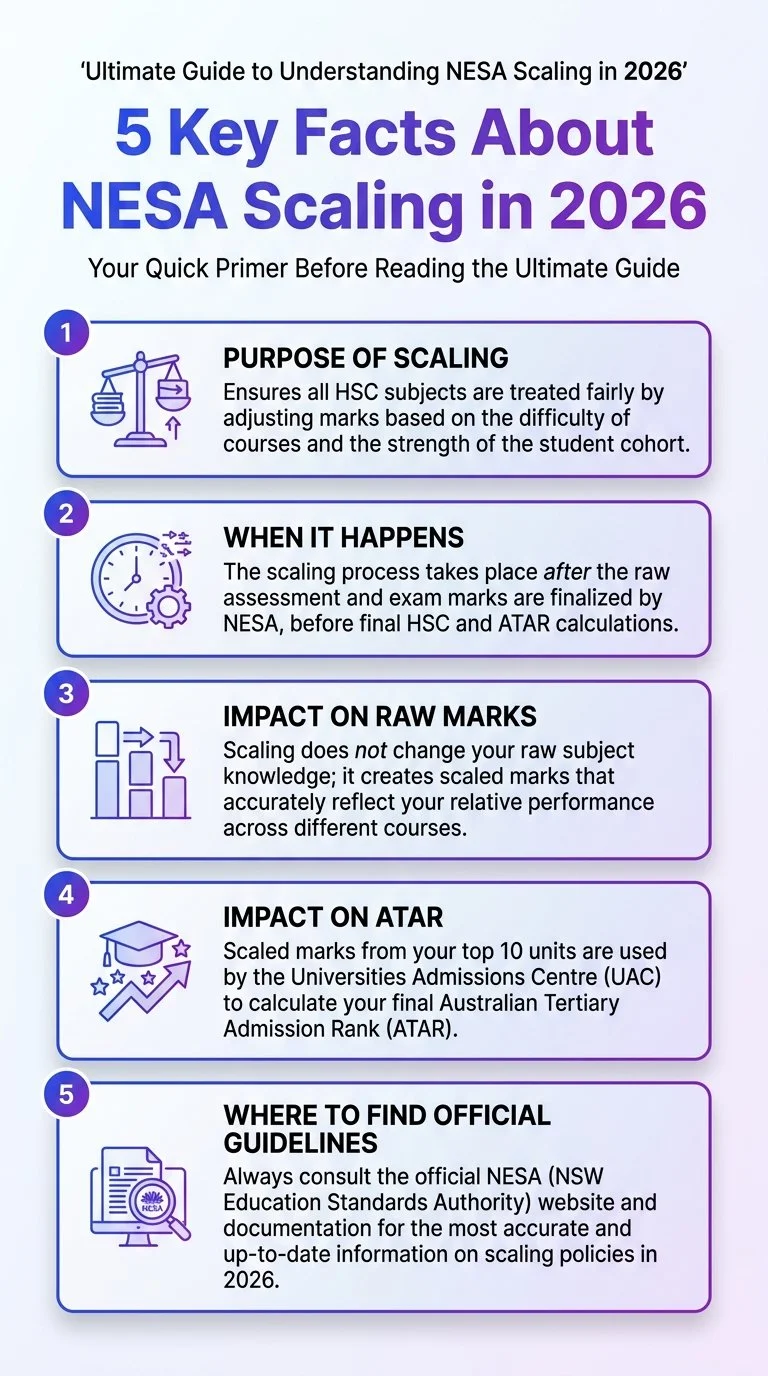
Infographic visualizing 5 key facts about NESA scaling in 2026, part of the ultimate guide.
The Subjects That Scale Best (and Worst) in 2026
Here's where it gets strategic. Understanding NESA scaling in 2026 means knowing which subjects consistently attract high-performing cohorts and which ones don't.
High-Scaling Subjects
Mathematics Extension 1 and Extension 2 consistently sit at the top of scaling tables. The cohort self-selects for ability.
English Extension 1 and Extension 2 scale strongly. If you can write and analyse at an advanced level, these subjects reward you disproportionately.
Language Extension courses (Latin, French Continuers, German Continuers, Italian Continuers, Japanese Continuers) produce some of the strongest scaled outcomes in the entire HSC. The students who sit these subjects are typically dedicated, high-ability learners who perform well across everything they do.
Science Extension is a newer subject that attracts strong cohorts and scales well as a result.
Lower-Scaling Subjects
Subjects with large, diverse cohorts (like some general courses) tend to scale lower because the average student performance across those cohorts is lower.
This doesn't mean avoid them. It means understand what you're working with.
The Biggest Myths About NESA Scaling in 2026 (Debunked)
Most schools teach what to learn, but they rarely teach how scaling works. That gap produces myths. Let's kill them.
Myth 1: "Scaling will boost me even if I perform badly"
Wrong. Scaling adjusts your mark relative to your cohort. If you're in the bottom half of a high-scaling subject, you can still end up with a lower scaled mark than someone who aced a lower-scaling subject.
The strategy only works if you perform well within your chosen subject. Your relative rank within the cohort drives your outcome.
Myth 2: "Picking easy subjects guarantees a better ATAR"
Wrong again. "Easy" subjects often have large, weaker cohorts, which means lower scaling. You might score 90 raw and have it scaled down to 75 because everyone around you also scored well but the group wasn't considered academically strong overall.
Myth 3: "My school assessment marks don't really matter"
This one is dangerously wrong. Your school assessment rank is what feeds into moderation. A poor rank within your school can drag your aligned mark down significantly, regardless of how well you perform in the HSC exam.
It feels like hard work every time you submit an assessment task. It feels productive. But if you're not studying strategically and maintaining your rank, it doesn't get you the results you want.
Myth 4: "Scaling is random or unfair"
Scaling is actually the most meritocratic part of the HSC. It rewards genuine academic ability rather than raw memorisation in a subject that happens to have an easy marking scheme.
How to Use Your Understanding of NESA Scaling in 2026 to Pick the Right Subjects
This is where strategy meets execution. Here's a simplified framework for choosing subjects in 2026.
Know your strengths. Scaling helps strong students. If you're genuinely talented in a subject, the scaling system amplifies your performance.
Check historical scaling data. LearnMate and UAC publish scaling data. Look at what subjects had the highest median scaled marks over the last few cycles and use that as a guide.
Avoid picking hard-scaling subjects you hate. If you struggle with a subject, even strong scaling won't save a poor performance. Choose subjects where you can realistically outperform the cohort average.
Consider Extension subjects seriously. Extension 1 and 2 courses in both Maths and English add units that can replace weaker ones in your ATAR calculation. They're high-effort but potentially high-reward if you have the aptitude.
Don't overload yourself. Cognitive load is real. Stretching yourself across too many high-scaling, high-difficulty subjects leads to burnout and underperformance across the board.
Why Your Internal Rank Is the Most Underrated Factor in NESA Scaling
We need to say this louder for the students at the back.
Your school assessment rank is the single most controllable variable in your ATAR journey. Not your raw marks. Your rank relative to your classmates.
Here's why. During moderation, NESA takes the distribution of your school's HSC performance and maps your class's assessment marks onto it. The student ranked first internally gets the top moderated assessment mark. The student ranked last internally gets the bottom one.
If you're in a school where your peers are strong, being ranked first in your cohort becomes even more valuable. Your moderated mark will be pulled up by the strength of the group.
This is why we don't just teach content at Lux Tuition. We mentor students on study habits, exam techniques, and confidence so they can outperform their peers consistently, not just once.
Our HSC Chemistry tutoring in Blacktown is built specifically around this principle. We break theory into the smallest possible parts, teach it with consistent language, and run students through exam-style questions every single session so they're always operating ahead of their cohort.
Active Recall, Spaced Repetition, and How Science-Backed Study Beats Raw Grinding
Understanding NESA scaling in 2026 is one thing. Actually performing well enough to benefit from it is another.
Stop grinding. Start strategizing.
Students are left relying on study methods that are high effort and low results. Re-reading notes. Highlighting textbooks. Copying out definitions. It feels productive. But the research is clear: passive review creates the illusion of learning without the retention.
The two methods that actually work are active recall and spaced repetition.
Active Recall
Instead of reading your notes, close them and try to retrieve the information from memory. Every time you successfully recall something without looking, you strengthen that neural pathway. This is what retention actually looks like.
We build every session around active recall at Lux Tuition. At the end of every single class, students sit an Exit Test where they have to prove they retained what was taught that day. No exceptions.
Spaced Repetition
The forgetting curve is real. Your brain forgets information exponentially unless you revisit it at increasing intervals. Spaced repetition exploits this by scheduling review sessions at exactly the right time to maximise retention without wasting effort.
Combined with active recall, this approach is how our students outperform their cohort averages, which is precisely what drives higher scaled marks.
Grab our free HSC study guide for a full breakdown of science-backed strategies you can implement today, no textbook purchase required.
How Lux Tuition Helps Students Maximise Their Scaled Marks in 2026
Our goal is to guide you along the easiest possible path to a Band 6. That's not a sales pitch. It's our entire curriculum philosophy.
We understand that struggle is part of the process. The founder of Lux Tuition used to hate Chemistry. Through much struggle, he found a method of learning that enabled him to achieve a Band 6 in Chemistry without making any notes or buying a single textbook. That experience is baked into how we teach.
Theory is broken down by our tutors into the smallest possible parts and taught with simple consistent language to students. We don't start with the full complexity of an HSC module. We start with the foundation, confirm mastery with the Exit Test, and only then build upward.
Here's what that looks like in practice across our key subjects:
HSC Chemistry
Chemistry scales well when you master it. We cover all Modules 1-8 with a focus on exam-style questions that mirror exactly what NESA will test you on. Chemistry is a difficult subject. We simplify it so you don't have to struggle.
HSC Mathematics
Extension Maths is one of the strongest scaling subjects available. Our mathematics tutoring from Year 3 to Year 12 is built around problem-solving systems, not just content coverage. We teach you how to think through problems, not just memorise procedures.
HSC English
English Extension scales powerfully. Our English tutoring focuses on the analytical and creative writing skills that lift students into the top bands. When you learn our methods, you can write an English creative about anything and get a Band 6, even if its about Hitler.
Sessions are available at our Blacktown location, just minutes from Blacktown Station. Check our current pricing (Standard Lux Classes start at $60 per subject, with Intensive Year 11-12 packages available) or enrol today to get started.
A Practical NESA Scaling Checklist for HSC Students in 2026
Use this before you sit your next assessment task or make any subject selection decision.
Know your current rank in every subject at your school. Ask your teacher if you're not sure.
Check the scaling history of every subject you're considering. Use publicly available UAC data or the LearnMate scaling reports.
Calculate your current ATAR trajectory using one of the free ATAR calculators available for NSW students.
Identify your two weakest ranked subjects and treat improving those ranks as your first priority, since ATAR uses your best 10 units.
Switch your study methods to active recall and spaced repetition immediately if you haven't already. Your time is limited and passive study is burning it.
Consider whether Extension subjects in your strongest areas could replace weaker units in your ATAR calculation.
Get support early. Catching up in Term 4 is significantly harder than staying ahead in Term 1 and 2.
Conclusion: Your Ultimate Guide to NESA Scaling in 2026 Starts Here
This ultimate guide to understanding NESA scaling in 2026 gives you everything you need to stop being a passive participant in the HSC and start treating it as a strategic game you can win.
Scaling rewards students who perform above their cohort average in strong subjects. That's the entire mechanism in one sentence. Everything else in this guide is about how to engineer that outcome systematically.
The students who get top ATARs aren't always the hardest workers in the room. They're the smartest strategists. They chose the right subjects, maintained their internal ranks, studied with science-backed methods, and walked into exams with exam technique that was already second nature.
That's what mastery-orientated tutoring looks like. That's what we do at Lux Tuition.
If you want a team that doesn't just teach content but mentors you on study habits, exam techniques, and confidence, check out our tutoring FAQ or come meet us near Blacktown Station. We're ready when you are.
Frequently Asked Questions
What is NESA scaling and how does it affect my ATAR in 2026?
NESA scaling is a statistical process that adjusts your raw HSC marks based on the academic strength of the cohort sitting the same subject. Understanding NESA scaling in 2026 is essential because it means your ATAR is not just about how well you perform in absolute terms, but how well you perform relative to others in your subject.
Which HSC subjects have the best scaling in 2026?
Mathematics Extension 1 and 2, English Extension 1 and 2, and Language Extension courses (Latin, French, German, Italian, Japanese) consistently produce the highest scaled marks. Students aiming for top ATARs in 2026 should factor scaling data into their subject selection alongside personal aptitude.
Does studying harder automatically improve my scaled mark?
Harder work only helps if it translates to performing above your cohort average in a well-scaling subject. Science-backed methods like active recall and spaced repetition are far more efficient than passive grinding and directly drive the kind of cohort-beating performance that scaling rewards.
Can I still get a high ATAR in 2026 if I chose lower-scaling subjects?
Yes, but you need to perform exceptionally well within those subjects and ensure your best 10 units (including English) are still competitive. Understanding NESA scaling in 2026 means knowing it's about relative performance within each cohort, not absolute difficulty.
How important is my internal school ranking compared to my HSC exam mark?
Both matter equally since assessment and HSC exam are each worth 50% of your examination mark. However, your internal rank is the most controllable variable because it determines the moderated assessment mark you receive, regardless of what your raw task scores were.
Is it too late to change subjects to improve my ATAR scaling in 2026?
Subject changes become harder and riskier the later in the HSC journey you attempt them. In 2026, the best strategy if you are currently in Year 11 is to review your subject selection now, consider whether Extension options suit your strengths, and invest in targeted tutoring to strengthen your rank in your current subjects.
How does tutoring help with NESA scaling outcomes?
Tutoring that focuses on exam technique, active recall, and consistent practice lifts your performance above your cohort average, which is the direct mechanism through which better scaling outcomes are achieved. At Lux Tuition in Blacktown, our mastery-orientated approach is specifically designed to give students the competitive edge that scaling rewards.
